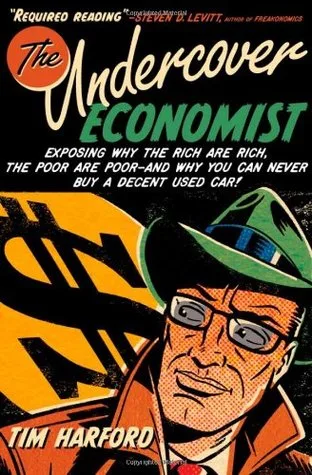
Tim Harford explains how price discrimination, scarcity power, and information asymmetry dictate the costs of daily life. He uses the high price of coffee at transit hubs to demonstrate how landlords capture value through location-based monopolies rather than product quality. The text applies the principles of game theory and neoclassical economics to explain why used car markets struggle with hidden defects and how supermarkets use complex loyalty schemes to identify customers willing to pay a premium. Harford also examines large-scale systemic structures, including the rise of China’s economy and the functional mechanics of government-run healthcare systems versus private markets.
This book is for non-specialists who want to understand the hidden incentives behind commercial interactions. Readers gain a framework for spotting how businesses target their spending habits and learn to identify when a market is efficient or failing. The material provides a toolkit for analyzing world events through the lens of rational choice. Individuals walk away with the ability to decode price signals and understand the strategic logic governing global trade and local retail behavior.
- Published
- 2005
- Language
- EN
More by Tim Harford
See all →