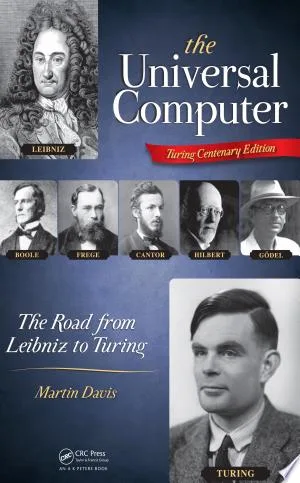
Martin Davis traces the evolution of modern computing through the mathematical logic developed between the seventeenth and mid-twentieth centuries. The narrative follows a lineage of thinkers starting with Leibniz’s dream of a universal calculus, moving through Boole’s algebraic logic, Frege’s predicate logic, and Cantor’s set theory. Davis explains how Gödel’s proof of incompleteness and Hilbert’s formalist program culminated in Alan Turing’s theoretical model of a universal machine. By analyzing these specific intellectual breakthroughs, the book demonstrates that the digital computer began as a philosophical inquiry into the boundaries of human reasoning.
Computer scientists and students of the history of ideas read this book to understand the theoretical scaffolding behind hardware and software. The reader gains a technical appreciation for how abstract symbolic logic transformed into programmable physical systems. By examining the biographies and professional struggles of these logicians, readers walk away with a clear perspective on why modern computation functions as a general-purpose tool rather than a collection of specialized calculators.
Outward-looking; a moderate read.
Best for readers like The Evidence Seeker. Which reader are you?
- Published
- 2018
- Publisher
- CRC Press
- ISBN
- 9781466505209
- Language
- EN