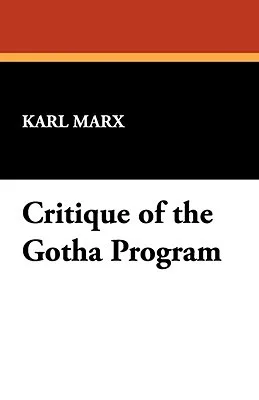
Karl Marx wrote this text as a private letter to criticize the draft platform of the newly unified German Workers' Party. He rejects the Gotha Program’s concessions to Lassallean socialism, specifically the notion of fair distribution and the iron law of wages. Marx establishes the material distinction between the lower and higher phases of communist society. He argues that in the initial stage, workers receive goods based on their labor contribution, whereas the higher phase operates on the principle of from each according to his ability, to each according to his needs. He also clarifies the role of the state, defining the transition period as a revolutionary dictatorship of the proletariat.
Political theorists and students of socialist history read this document to understand Marx’s specific vision for post-capitalist economic organization. It provides a technical framework for how a transitional society moves beyond the value-form and commodity exchange. Readers walk away with a clear definition of Marx’s stance on the state's eventual disappearance and a critique of equal rights as a bourgeois legal concept. The text serves as a primary source for distinguishing scientific socialism from state-led reformism and clarifies the functional requirements of a planned economy.
- Published
- 1875
- Language
- EN
Quotes by Karl Marx
More →The philosophers have only interpreted the world in various ways; the point is to change it.
Theses on Feuerbach