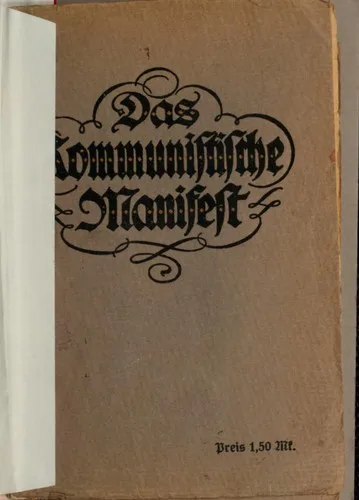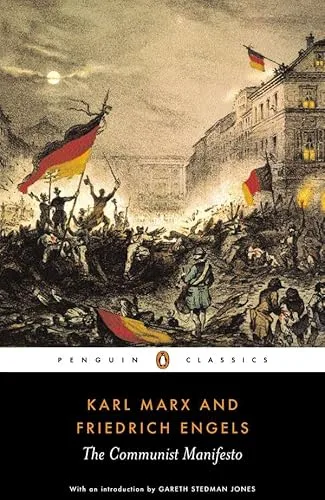
The Communist Manifesto
The Communist Manifesto outlines a theory of historical development driven by class struggle between the bourgeoisie, who own the means of production, and the proletariat, who sell their labor. Marx and Engels argue that capitalism inherently leads to the concentration of wealth and the exploitation of workers, eventually triggering a revolution. The text details the abolition of private property, the centralization of credit and transport in state hands, and the eventual dissolution of class distinctions. It defines the specific economic shifts from feudalism to industrial capitalism.
This book serves students of political economy, history, and sociology who seek to understand the origins of socialist theory. Readers obtain a framework for analyzing social hierarchy and industrial labor relations through a materialist lens. The text provides a technical vocabulary for discussing systemic inequality and the internal contradictions of global markets. People read it to grasp the ideological foundations of twentieth-century geopolitical conflicts and the specific mechanics of Marxist historical analysis.
Deep and outward-looking; a moderate read.
Best for readers like The Systems Thinker. Which reader are you?
Insights from The Communist Manifesto
“The history of all hitherto existing society is the history of class struggles.”
Every single era of history is just a story of people fighting over who owns what. It makes you see every conflict as a struggle between those at the top and everyone else.
“The need of a constantly expanding market for its products chases the bourgeoisie over the entire surface of the globe.”
Capitalism is basically a giant machine that never stops moving. It forces us to keep making and buying new things just to keep the whole system from collapsing.
“All that is solid melts into air, all that is holy is profaned.”
Everything sacred or traditional gets turned into a business transaction eventually. Even family ties and old customs carry a price tag now.
“These labourers, who must sell themselves piecemeal, are a commodity.”
Living in this system means we are mostly just parts in a machine. Our value ends up being tied to how much work we can churn out in an hour.
- Published
- 1848
- Language
- EN
Quotes by Karl Marx
More →The philosophers have only interpreted the world in various ways; the point is to change it.
Theses on Feuerbach