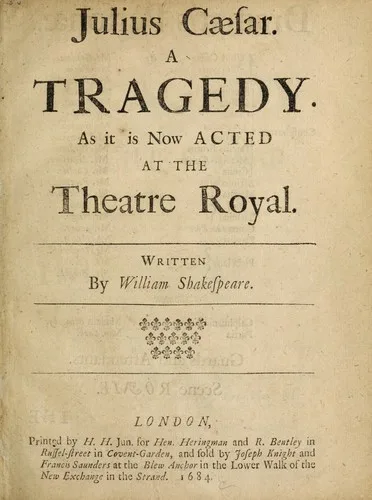
William Shakespeare’s tragedy centers on the assassination of the Roman dictator and the subsequent civil war. Brutus, a noble senator, joins a conspiracy led by Cassius to kill Caesar, fearing that his ambition will lead to a monarchy and the end of the Republic. Following the murder at the Senate, Mark Antony delivers a funeral oration that turns the Roman populace against the conspirators. The narrative concludes with the military defeat of Brutus and Cassius at the Battle of Philippi and their subsequent suicides.
This drama serves readers interested in political theory and the ethics of leadership. Students of history and literature analyze how the play portrays the shift from a republic to an empire through the use of rhetoric and public manipulation. Readers observe how private friendship conflicts with civic duty and how the power of speech shapes political outcomes. They finish the text with an understanding of how internal division and pride can lead to the collapse of a governing system.
Deep and thought-provoking; a moderate read.
Best for readers like The Deep Diver. Which reader are you?
Insights from Julius Caesar
“Not that I loved Caesar less, but that I loved Rome more.”
Brutus kills his best friend because he loves a version of Rome that might not exist anymore. It is heartbreaking to watch a good man ruin his life for a political ideal.
“The fault, dear Brutus, is not in our stars, but in ourselves.”
Cassius uses flattery like a weapon to get Brutus on his side. He knows exactly which insecurities to poke to make a moral man do something terrible.
“Beware the ides of March.”
Caesar ignores every single red flag because he thinks he is invincible. His ego makes him blind to the people literally sharpening knives behind his back.
“For Brutus is an honorable man.”
Antony's speech at the funeral is a masterclass in manipulation. He repeats the word honorable until it becomes an insult and starts a literal riot.
- Published
- 1656
- Publisher
- Oxford University Press
- ISBN
- 9780198320272
- Language
- EN
Quotes by William Shakespeare
More →There is nothing either good or bad, but thinking makes it so.
Hamlet
What's past is prologue.
The Tempest
The fault, dear Brutus, is not in our stars, but in ourselves.
Julius Caesar