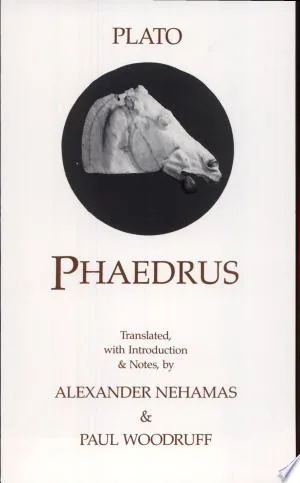
Plato’s dialogue takes place on a grassy bank outside Athens, where Socrates and Phaedrus examine three speeches concerning the nature of love and the human soul. The text argues that divine madness, or eros, acts as a catalyst for the soul to regain its wings and perceive absolute truths. Socrates utilizes the famous chariot allegory to illustrate the internal struggle between intellectual discipline and physical desire. Beyond romance, the work analyzes the mechanics of rhetoric, criticizing written texts for their inflexibility while advocating for a living, dialectical approach to philosophy.
Students of classical philosophy and rhetoric read this edition for its clear, precise translation and technical footnotes. Nehamas and Woodruff provide a structural outline that helps readers track the shift from erotic poetry to the technical definitions of public speaking. The inclusion of early Greek love poems in the appendix allows a reader to compare Plato’s arguments with his cultural predecessors. One walks away with a specific framework for evaluating the morality of persuasion and an understanding of how Socrates links interpersonal attraction to the pursuit of knowledge.
Deep, contemplative and open-ended; a demanding read.
Best for readers like The Literary Connoisseur. Which reader are you?
- Published
- 1995
- Publisher
- Hackett Publishing
- ISBN
- 9780872202207
- Language
- EN